


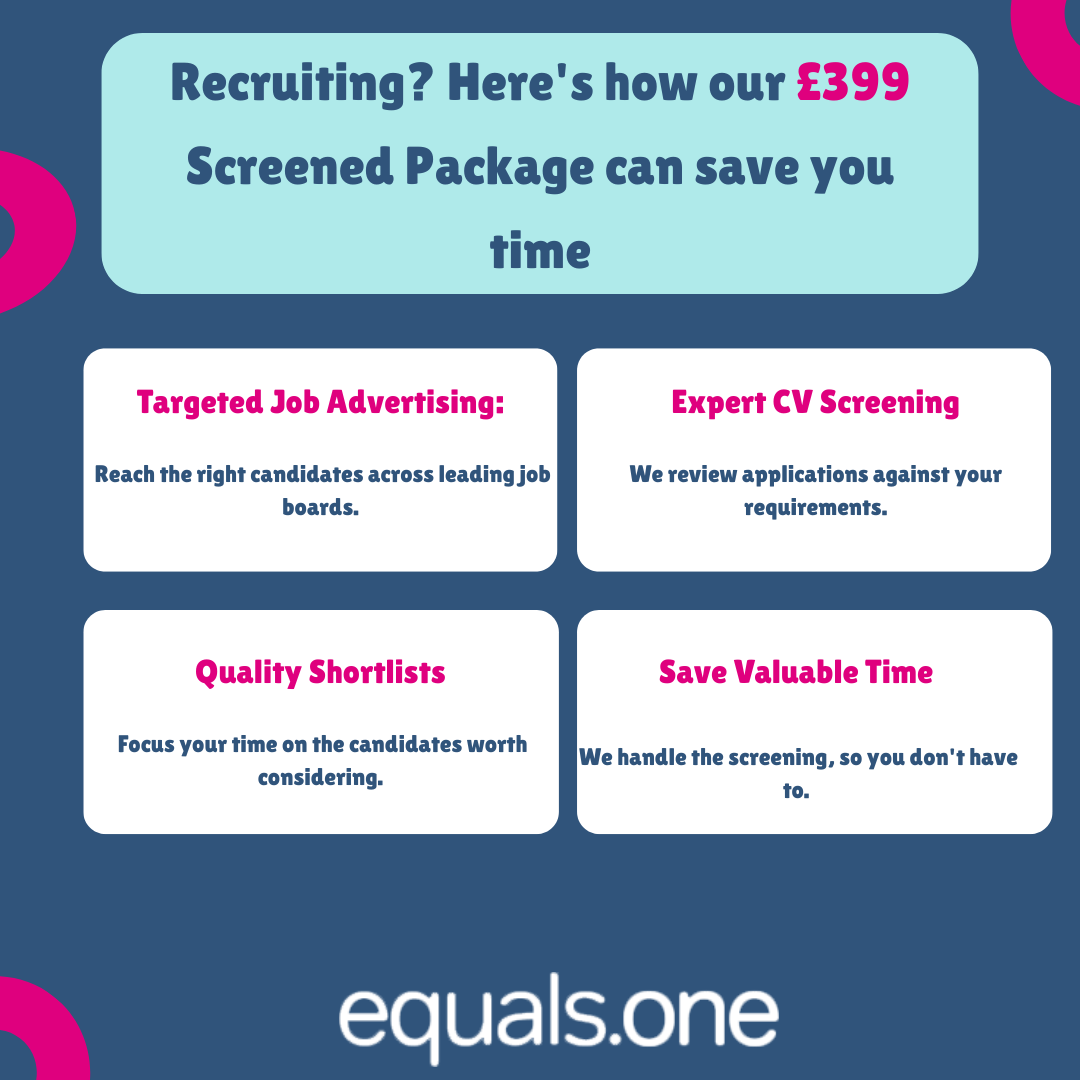
Recruiting? Here’s how our £399 Screened Package can save you time
Your job title could be attracting the wrong people
The job title is one of the most important parts of any recruitment campaign. It’s also surprisingly easy to get wrong.
Businesses often use internal job titles that make complete sense within their organisation but mean very little to someone searching for a new job. Equally, a title that is too broad can attract candidates from a much wider range of backgrounds than you intended.
Think about what your ideal candidate is actually typing into a job board. Is it the same title you’re advertising?
Sometimes, a small change can make a big difference to who sees and applies for your vacancy. The aim isn’t to come up with the most creative title – it’s to use one that accurately reflects the role and is easily recognised by the people you want to reach.
Are you being clear enough about the experience you need?
If certain experience is genuinely essential, say so.
We’ve seen campaigns where an employer needs someone from a very specific industry or professional background, but the advert doesn’t make that clear enough. The result? Lots of applications from people with broadly similar experience, but not the specific knowledge needed to do the job.
There’s nothing wrong with having non-negotiables. The key is making them obvious.
Rather than hiding essential requirements halfway down a long list, make sure candidates can quickly understand what they must have before applying.
This saves your time – and theirs.
Salary and location matter more than you might think
You may have found the perfect candidate on paper, but if the salary isn’t in line with their expectations or the journey to work isn’t realistic, the process is unlikely to go very far.
Being upfront about salary, working hours, location and whether a role is office-based, hybrid or remote helps candidates make an informed decision before they apply.
Location is particularly important for site-based roles. A candidate might technically live within the same city or county, but that doesn’t necessarily mean the daily commute is practical.
The clearer you are from the start, the less time you’ll spend speaking to candidates who were never going to accept the role in the first place.
Trying to appeal to everyone can backfire
It’s tempting to write an advert that casts the widest possible net. After all, more applicants means more choice.
But does it?
If an advert is too broad, you may end up attracting everyone – apart from the person you actually need.
A good job advert should help the right candidate recognise themselves in the role. It should be clear about what the job involves, what experience is needed and what the employer can offer in return.
That doesn’t mean writing an endless list of requirements. In fact, overly long adverts can put good candidates off altogether.
Focus on what really matters.
Don’t make your wish list your essential list
While being clear about essential experience is important, there’s a balance.
If your advert lists 15 requirements as “essential”, you could be filtering out perfectly capable candidates before they’ve even applied.
Ask yourself which requirements someone genuinely needs from day one and which could be learned once they’re in the role.
Does someone really need five years’ experience, or would three years of strong, relevant experience be enough? Do they need experience with your exact software, or could someone familiar with a similar system pick it up quickly?
Being specific helps attract the right candidates. Being unnecessarily restrictive can have the opposite effect.
Screening is where the real work begins
Getting applications is only the first step.
The real challenge is working out who is worth speaking to.
A CV rarely gives you the full picture, which is why effective screening is so important. It’s about looking beyond keywords and job titles to understand whether someone’s experience genuinely matches the role.
It’s also about spotting the practical things that can easily derail the process later – salary expectations, location, availability and any essential qualifications or experience.
Good screening doesn’t mean rejecting anyone who isn’t a 100% match. It’s about identifying the candidates who have the right foundations and the potential to succeed.
Filter candidates without putting good people off
There are plenty of ways to improve the quality of applications without creating barriers for strong candidates.
Use a clear, searchable job title. Be honest about the salary and location. Highlight genuine non-negotiables early in the advert. Keep your list of essential requirements realistic.
You can also use simple screening questions at the application stage to confirm the basics.
For example, if a driving licence is essential, ask. If candidates must hold a particular qualification, confirm it. If the role is fully office-based, make that clear.
A few well-chosen questions can save hours of CV screening without asking candidates to complete lengthy application forms or jump through unnecessary hoops.
It’s about quality, not quantity
Ultimately, the success of a recruitment campaign shouldn’t be measured by how many applications you receive.
It’s about whether you find the right person.
At Equals One, we know that reviewing hundreds of applications can quickly become a full-time job – particularly for smaller businesses without an internal recruitment team.
Our £399 + VAT screened recruitment package combines job advertising with candidate screening, helping employers reach the market while reducing the time spent working through unsuitable applications.
Because sometimes, the problem isn’t getting people to apply.
It’s finding the right people amongst them.